
Narrative and stories have long been used in education, including higher education and narrative is also used as a method in (educational) research – collecting personal narratives for example but narrative also has implications for the structure, content and delivery of teaching material (including the lecture) which is where the focus of this research lies.
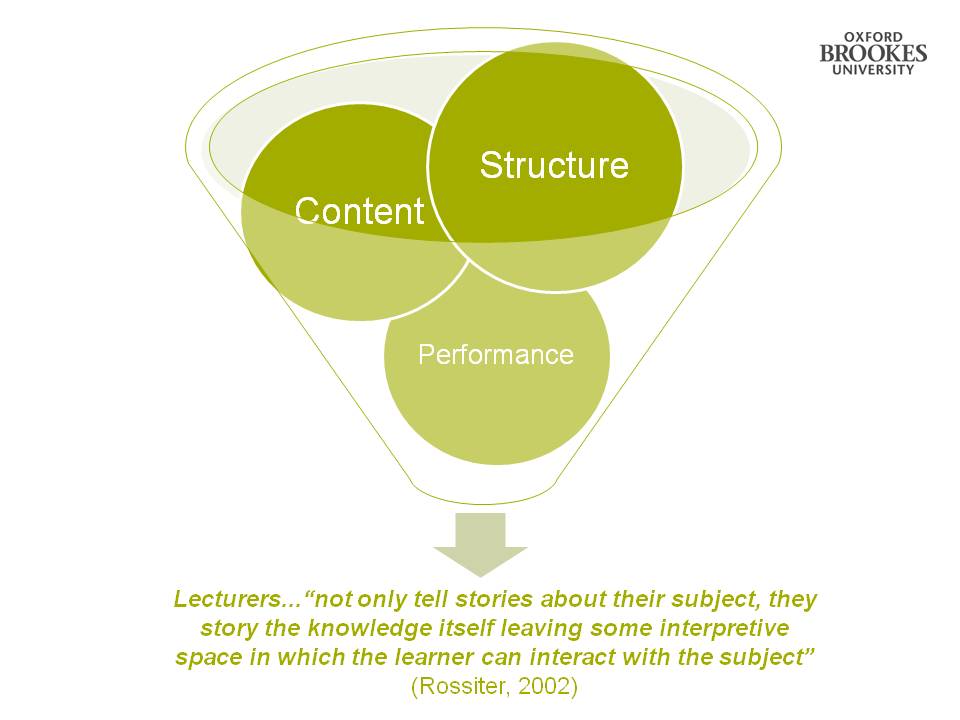
Lecturing can involve narrative in at least three interlinked ways. First, the delivery of the teaching material in a lecture can be seen as a performance by the lecturer that has to convince the student audience by invoking a response that is beyond what might be expected from a simple statement of fact or information. Simply put, the lecturer has to move the audience in order to be effective.
Secondly, pedagogical knowledge itself can be thought of as narrative as the lecturer has chosen and crafted it themselves with the student audience in mind and so the content of the lecture itself can be thought of as narrative.
Finally, the lecture can have an overall narrative structure and may also contain various narrative devices within its duration.
So why use narrative? Why not just state the facts? Rossiter’s quote hints about the engagement that narrative affords..."leaving space in which the learner can interact with the subject".
In my research I’m using a framework developed by Nancy Duarte in her book Resonate, which focuses on the importance of stories - primarily in business presentations - as a means of persuading an audience to engage with a product, brand, mission statement, set of values etc. Duarte developed her framework by analysing famous speeches and presentations by the likes of Martin Luther King, Steve Jobs, Richard Feynmann and others. Her framework draws on literary and cinematic traditions and focuses on the importance of engaging the audience through a contrasting dramatic rhythm in presenting and a structure that makes meaning clear through impassioned contrast.
Including emotion in a lecture doesn’t mean it should be half fact and half emotion, it means introducing appeal that invokes a response in the audience. This is most easily done through the use of stories and a recognisable narrative structure.
The importance of using stories is two-fold:
- They contain complex information, which the audience can make meaning from and that influences and inspires them.
- They allow the audience to make connections, engage and empathise through emotion.

Duarte’s presentational form is shown in the diagram below – it doesn’t suggest that all successful speeches or presentations should adhere to this format rigidly – it’s flexible.
Things to note:
- There’s a clear beginning, middle and end.
- There are two turning points in the structure to guide audience through the content and to separate the beginning from the middle and the middle from the end:
- The first one is a call to adventure showing the gap between what is and what could be – needs to be big to jolt the audience and create imbalance that they wantto be resolved;
- The second is a call to action, which identifies what the audience need to do or how they need to change – this signifies that the presentation is drawing to its conclusion.
- The back and forth structural motion pulls and pushes the audience to feels events are unfolding and so they will stay engaged as ideas and perspectives are unwrapped frequently.
Each presentation ends with a vivid description of the new bliss that’s created when the audience adopts the new idea but note that the form does not stop here as the presentation aims to persuade the audience to complete a subsequent action afterwards – crossing the threshold.

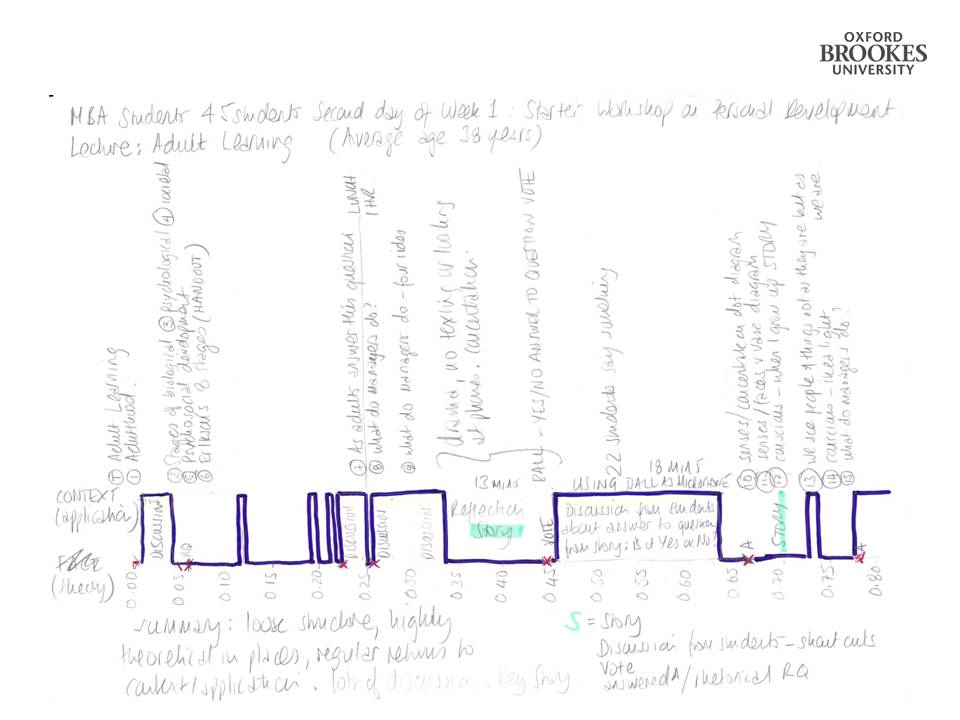
Below is a field note from one of the lectures that I have observed as part of my pilot work for my doctorate. It displays the contrasting rhythm described by Duarte but also has a planned story half-way through, which is the catalyst for a vigorous discussion amongst the class. The story is designed to create this response, rather than being a device for supporting theory or other teaching points made. I have called this type of story, Trojan Horse.
One of the clear points I noticed in observing all these lectures was the different ways that narrative was used by lecturers within their lecture. Some were designed and planned, some were spontaneous reactions, unconscious to the lecturer as stories and some had very deliberate intentions other than the story itself. So here is my typology of narrative within lectures so far.

References:
Duarte, N. (2010) Resonate – Present Visual Stories that transform Audiences. New Jersey: John Wiley& Sons
Rossiter, M. (2002) Narrative and Stories in Adult Teaching and Learning. ERIC Digest No. 241. [Online] Accessed at http://calpro-online.org/eric/docs/dig241.pdf

