Showing posts with label Stories. Show all posts

Monday, June 3, 2013

How is the lecture narrative?

This post is a write-up of the presentation I gave at Storyville13 - the Higher Education Academy (Arts and Humanities) conference in Brighton on 29-30 May 2013. Here's the Storify archive link for the event. The presentation was called The Role of Narrative in the Lecture: can we make lectures resonate through narrative structure?


Narrative and stories have long been used in education, including higher education and narrative is also used as a method in (educational) research – collecting personal narratives for example but narrative also has implications for the structure, content and delivery of teaching material (including the lecture) which is where the focus of this research lies.

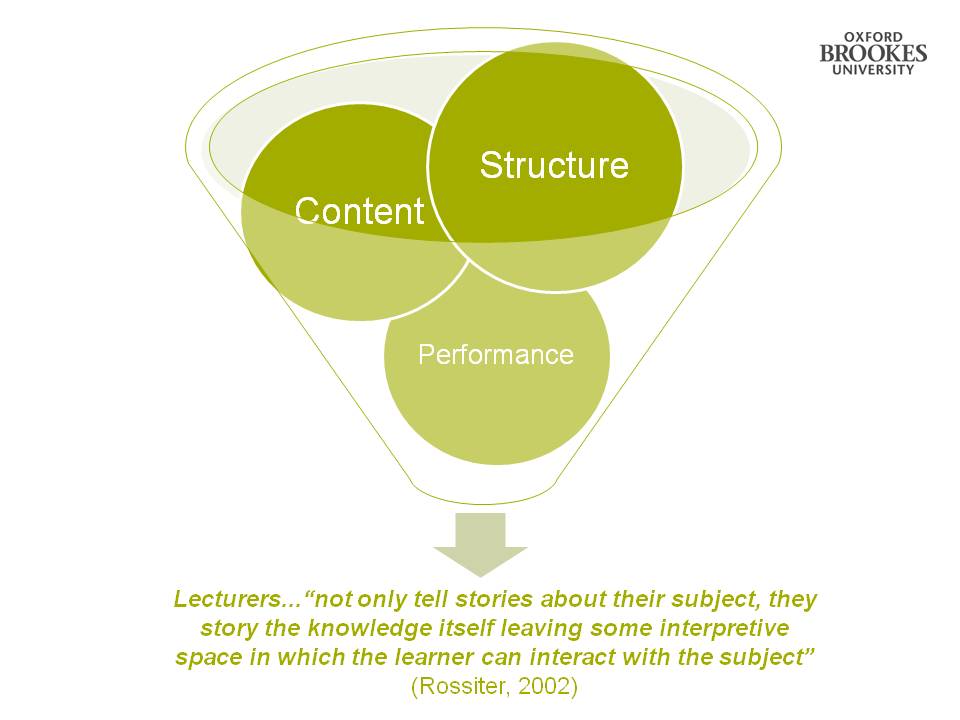
Lecturing can involve narrative in at least three interlinked ways. First, the delivery of the teaching material in a lecture can be seen as a performance by the lecturer that has to convince the student audience by invoking a response that is beyond what might be expected from a simple statement of fact or information. Simply put, the lecturer has to move the audience in order to be effective.

Secondly, pedagogical knowledge itself can be thought of as narrative as the lecturer has chosen and crafted it themselves with the student audience in mind and so the content of the lecture itself can be thought of as narrative.

Finally, the lecture can have an overall narrative structure and may also contain various narrative devices within its duration.

So why use narrative? Why not just state the facts? Rossiter’s quote hints about the engagement that narrative affords..."leaving space in which the learner can interact with the subject".


In my research I’m using a framework developed by Nancy Duarte in her book Resonate, which focuses on the importance of stories - primarily in business presentations -  as a means of persuading an audience to engage with a product, brand, mission statement, set of values etc. Duarte developed her framework by analysing famous speeches and presentations by the likes of Martin Luther King, Steve Jobs, Richard Feynmann and others. Her framework draws on literary and cinematic traditions and focuses on the importance of engaging the audience through a contrasting dramatic rhythm in presenting and a structure that makes meaning clear through impassioned contrast.

Including emotion in a lecture doesn’t mean it should be half fact and half emotion, it means introducing appeal that invokes a response in the audience. This is most easily done through the use of stories and a recognisable narrative structure.

The importance of using stories is two-fold:
  1. They contain complex information, which the audience can make meaning from and that influences and inspires them.
  2. They allow the audience to make connections, engage and empathise through emotion


Duarte’s presentational form is shown in the diagram below – it doesn’t suggest that all successful speeches or presentations should adhere to this format rigidly – it’s flexible.

Things to note:
  • There’s a clear beginning, middle and end.
  • There are two turning points in the structure to guide audience through the content and to separate the beginning from the middle and the middle from the end:
  • The first one is a call to adventure showing the gap between what is and what could be – needs to be big to jolt the audience and create imbalance that they wantto be resolved; 
  • The second is a call to action, which identifies what the audience need to do or how they need to change – this signifies that the presentation is drawing to its conclusion.
  • The back and forth structural motion pulls and pushes the audience to feels events are unfolding and so they will stay engaged as ideas and perspectives are unwrapped frequently.
    Each presentation ends with a vivid description of the new bliss that’s created when the audience adopts the new idea but note that the form does not stop here as the presentation aims to persuade the audience to complete a subsequent action afterwards – crossing the threshold.


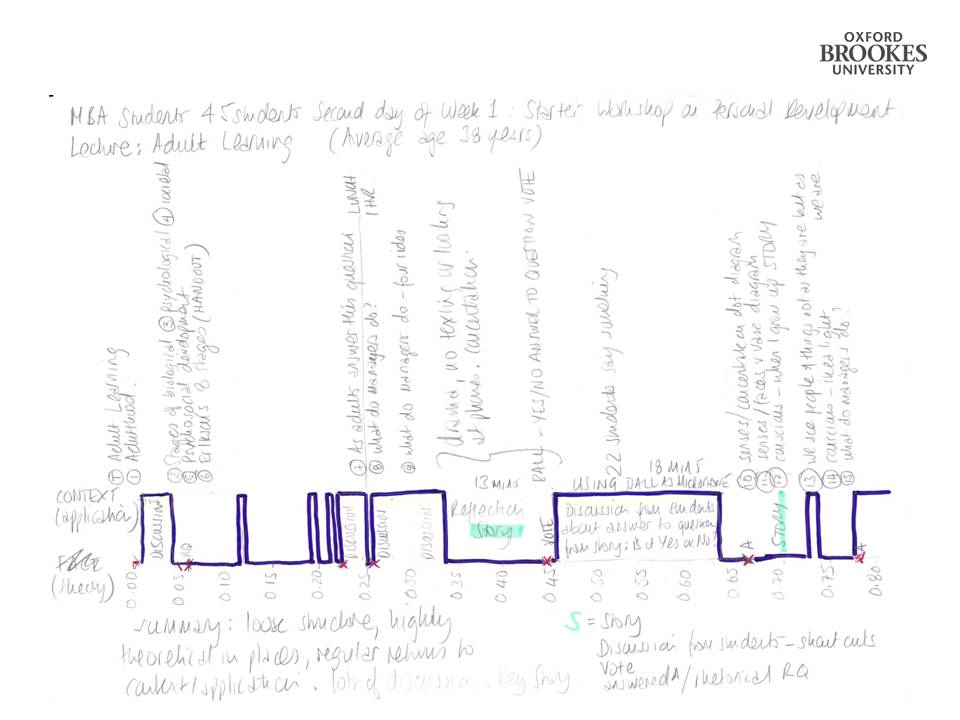
Below is a field note from one of the lectures that I have observed as part of my pilot work for my doctorate. It displays the contrasting rhythm described by Duarte but also has a planned story half-way through, which is the catalyst for a vigorous discussion amongst the class. The story is designed to create this response, rather than being a device for supporting theory or other teaching points made. I have called this type of story, Trojan Horse.


One of the clear points I noticed in observing all these lectures was the different ways that narrative was used by lecturers within their lecture. Some were designed and planned, some were spontaneous reactions, unconscious to the lecturer as stories and some had very deliberate intentions other than the story itself. So here is my typology of narrative within lectures so far.


References:

Duarte, N. (2010) Resonate – Present Visual Stories that transform Audiences. New Jersey: John Wiley& Sons
Rossiter, M. (2002) Narrative and Stories in Adult Teaching and Learning. ERIC Digest No. 241. [Online] Accessed at http://calpro-online.org/eric/docs/dig241.pdf


Monday, March 4, 2013

Narrative, Story and Plot and Why We tell Stories

Trying to describes what narrative is and what it isn't is complex. It's Oxford dictionary definition is 'an account that presents connected events'. This implies a linear timeline of a series of happenings and that those occurrences are connected to each other. Author Jake Arnott believes narrative is a powerful force. In BBC Radio 4's 'Something Understood' (broadcast on 5 August 2012) he suggests that the instinct to create stories is innate within people and that it is essential to our understanding of both the world and our own life. Narrative enables a person to join everything together and make sense of the series of perhaps random and unconnected events that make up the life experience.

EM Forster furthers this in Aspects of the Novel and explains the distinction between story and plot. “We have defined a story as a narrative of events arranged in their time-sequence. A plot is also a narrative of events, the emphasis falling on causality. The point about causality is key here.

“The king died, and then the queen died” is a story. 

“The king died, and then the queen died of grief” is a plot. The time sequence is preserved, but the sense of causality overshadows it. 

Or again: “The queen died, no one knew why, until it was discovered that it was through grief at the death of the king.” This is a plot with a mystery in it, a form capable of high development. It suspends the time sequence, it moves as far away from the story as its limitations will allow. 

However, Arnott takes issue with the notion of causality and argues that Forster's insistence that story, or more accurately plot, is 'mere' causality is wrong. He believes that story occurs without anything having had to happen and that it's not just an order of events. He cites Beckett's 'Waiting for Godot' as a play in which nothing much happens, and yet it resonates with a powerful sense of story.

Arnott proposes something that I haven't come across before - this idea that story or narrative can be independent of a series of events. In the programme he describes how a piece of music or works of art can have a narrative and that narrative may just be hinted at rather than formed.

I like this idea of narrative that isn't obvious and it's interesting to think about how narrative can exist without anything having happened.

Related to this, on a vicarious internet search, I found this lovely YouTube video of poet Phil Kaye. In it he talks about the first type of stories that he loved - doing impressions. He calls them 'immediate stories' that happen through changing the tone, pitch and timbre of your voice to give an entire context of belief or feeling. It occurred to me that this is not dissimilar to Arnott's idea of independent narrative.


Kaye goes on to explain his thoughts on the important question of why we tell stories. He describes the often simple intentions behind telling stories - to entertain or make some laugh, to warn, to scare or explain. This last one, to explain, is quite close to what I am researching which is the the telling of stories  in teaching.
 
Kaye suggests that we tell stories to feel alive and we do this because we like to believe our lives are a linear and predicatable set of events, which they can appear to be if looked at retrospectively. However, surrounding the narrative of events are a whole series of what-might-have-beens if, at any point, a different decision had been taken. People like to reasure themselves that they can plot out their lives and perhaps that they can control that causality mentioned earlier but there is whole area of chance surrounding the events that happen to us that makes us feel vulnerable. It is this vulnerability that is the impetus for storytelling, so we can connect with others and feel alive by marking an event.
 
So Kaye concludes that we tell stories to feel alive by making context of our past (events) whilst recognising the vulnerability that exists surrounding the narrative.


Friday, November 30, 2012

As Objects Move Around the World, They Gain Stories


Today I listened to BBC Radio 4's Desert Island Discs. The castaway was author and ceramicist Edmund de Waal, whom I knew about through his bestseller The Hare with Amber Eyes. The acclaimed book is about his ancestry and, in particular, a series of porcelain figures known as netsuke that he inherited from an uncle who lived in Tokyo.


Beautiful objects - netsuke

It was one of those radio programmes stays in your mind for a while. I think this resonance was for a couple of reasons. First, de Waal is a very personable interviewee and had enjoyed an enviable upbringing from which he pulled some evocative anecdotes. Second, he also had an interesting back story to his adult life in terms of his struggle to achieve success as a potter after he left university, which made one feel sympathetically towards him. Finally, he is an eloquent person with an economical but precise use of words that reveals a clarity of thought, which I find to be quite rare. I think that people usually overdose on information without having the time to organise and reflect on it and are therefore unable to make clear points. De Waal made several clear points, one of which - about the importance of objects or 'things' to people - I found profound.

Edmund de Waal's The Hare With Amber Eyes

The gist of it was this. As things, or objects, move around the world from hand to hand, they gain stories like a "patina". The objects that de Waal refers to are things that someone has made and spent time "thinking it through". The point de Waal makes is that their monetary value is inconsequential (partly because they are not for sale) but mainly because their value is "elsewhere". The value should also include all the patina which are the previous stories and also the story that you yourself are constructing through holding it. So when you pick an object up, you have two things - someone and a material and those two are the beginning of another story that adds to the patina.

De Waal also made another interesting point about the 'pleasures' of persistence and repetition at a craft, which I dwelt on and will try to apply to my cello practice!

However, it is the image of hands holding beautiful objects and somehow imbuing them with a story after story that resonates with me.

Apart from Talking Heads and Philip Glass, I didn't much care for de Waal's Desert Island Discs.


Wednesday, October 17, 2012

Stories are what make us human. We need to create new containers to tell the stories...


"Stories are what make us human. We need to create new containers to tell the stories." This was said by Dr Ramesh Raskar, a researcher at MIT's Center for Future Story Telling to Stephen Fry in Fry's Planet Word, broadcast in the UK exactly one year ago today as I type this. Dr Raskar was working on a sensory suit that would allow someone to experience the electronically captured movement of another person. Wearing the suit someone would be able to 'relive' the saved experiences of a long-gone grandparent for example - perhaps a relative you never actually knew. So the suit was the new container able to tell someones story to the wearer.

The quote about new containers to tell stories struck me a year ago when I watched the programme and I  have been periodically mulling it over since then. If a sensory suit is a new container, then what forms do the old containers take. Are they redundant and is that why we 'need' new ones?

I suppose that containers could be the oral storytelling tradition around the fire or the written word that replaced it, except that it didn't really replace it. The oral tradition is alive and well. My own city of Oxford is home to the developing Story Museum which focuses on performances, exhibitions and activities to support children's learning through stories. What is teh phenonmenal TED if not stories performed?

Likewise stories in the container of the printed word or books are still being published and sold. My husband alone keeps several bookstores in business.


Husband's book buying habits are out of control

Secondhand sellers now have access to international customers thanks to the Internet. New containers for books could be e-readers, like Kindle, but again they haven't replaced books or magazines yet.

I keep reading on social media that digital storytelling is replacing linear narrative. I'm reading Frank Rose's excellent book The Art of Immersion - how the digital generation is remaking Hollywood, Madison Avenue, and the way we tell stories. The term immersion describes the way that audiences can become individually and collectively participatory in a narrative using different media, and able to shape and transform the story in a manner that is uniquely afforded by the Internet. For me,  the books sort of builds on Janet Murray's Hamlet on the Holodeck - the Future of Narrative in Cyberspace, which amazingly was published way back in 1997. Are these (ironically) books both describing new containers for stories - ones that are digital?

I also really like Frank Rose's blog Deep Media - on narrative in the digital age. Deep media is opposite of mass media. Rose has just written his account of a recent New York conference Future of Storytelling - reinventing the way stories are told (clip about FOST below).


In his review of the conference Rose describes an  initiative where data dumps, such as real estate or sports statistics, are automatically transformed into stories by software apps (or bots). The stories render the data much more understandable to readers trying to comprehend performance and trends. So maybe our stories are destined to come from bots and not brains via books in the near future. Strange to think that the quote at the beginning 'stories are what makes us human' can lead to a scenario where ro(bots) are creating the stories.

Finally, I am looking forward to reading Jonathan Gottschall's book - The Storytelling Animal - How Stories Make Us Human which seeks to explain how stories change our behaviour.