Showing posts with label PhD. Show all posts

Friday, August 8, 2014

Students' Experience of University Class Sizes

Teaching
The John Henry Brookes lecture theatre at Oxford Brookes University SOURCE: Oxford Brookes website

The recent Higher Education Policy Institute/ Higher Education Academy report on student academic experience raises many issues but of particular interest to me were points made about students' experience of class sizes and student absenteeism.

Class size, student attendance and teaching contact time are usually investigated in relation to student performance. Much has been researched and written about student views on their experience of class size and how much teaching time they get and both class size and contact time are seen as proxy indicators of teaching quality. Student absenteeism in higher education has become a consistent problem for universities and their teaching staff. However, whilst it is common to hear of lecturers bemoaning lack of student attendance there little written on the views of students who do attend teaching sessions and whether there is any impact on them as a result of their missing fellow students. Instead the focus tends to be on asking students why they miss classes.

Class Size

Figure 11 below, taken from the HEPI/HEA report, shows a strong relationship between the decline in perceived academic benefits as class size increases . Basically students are positive about the benefits of class sizes between one to 15 students but then there is a:
"...striking decline in the proportion of students perceiving educational benefits as the size of class increases, especially when they reach lecture sized groups. Even medium sized seminar classes see notably fewer students receiving benefits compared with tutorial sized groups."
For tutorial/small seminar sized groups of 6-15 students 42% of students felt they gained 'a lot' educationally. This figure falls to only 20% for groups of 16-50 students.

(SOURCE: HEPI/HEA, 2014 page 24)

The main question for me here is why does the perceived benefit decrease so quickly at a relatively low class size? The majority of students' contact time is spent in classes larger than 15 students. The implication from the report seems to be that the reasons is that interaction between staff and students is more feasible in small classes but is this the whole story? From my own, admittedly small-scale, interviews with students for my doctorate research, it seems there may be other interrelated factors involved. Students, especially those coming from a private education, are used to a secondary education system involving these small interactive classes. This is what has served them well (if they have got into the university and onto the course of their choice). It is also a stark contrast to the standard university first year teaching model of very large lectures and sets of identical seminars. So students believe they learn best in small classes, whether or not they have them at university. They are also used to having a closer relationship with their teachers compared to their lecturers, who may not even know their name, especially in the first year. But in addition, students often don't know each other within larger cohorts. This means they also cannot gauge the extent to which other students are understanding what's being taught in a session. This lack of relationships in a larger class size inhibits the asking of questions and therefore reinforces the feeling of not being known. This generates a feeling of anonymity, which is again reinforced as a class size increases. Lecturers often say to students at the beginning of a lecture,
"Feel free to interrupt if you have any questions or there's anything you don't understand."
But students come to know that questions risk not only making them look bad in front of many other students but also that they risk taking the lecturer away from set of PowerPoint slides that needs to be completed within the hour and thus incurring the wrath of their fellow students. Students reported in my research interviews that they had very mixed feelings about other students asking questions in a lecture, and would not themselves ask a question in case the other students had the same views as them. Instead, students saved questions to ask in seminars, where they said they could better assess whether the understanding and feeling of other students and would not look bad in front of others.

Student Attendance

Research on student attendance at classes usually investigates the correlation is between attendance and student achievement. Attendance has been shown to decrease over the duration of a module showing significant decreases when coursework submission is due on other modules (Van Blerkom, 1992). Much less attention has been paid to the relationship between class size and attendance with the accepted view that the larger the class the higher the absenteeism because students feel more anonymous and that their lack of attendance will not be noticed. The HEPI/HEA report states that students miss less than 10% of their scheduled teaching contact time.

The main reasons given for absenteeism is that students did not find the lectures very useful and that the notes were available online. This begs the question what is the additional benefit to students of physically attending lectures? 


From my own research students did not give overly reassuring answers to this question but did mention that the lecturer would always give additional information to what was in the notes and 'may' give advice about the assignments which would otherwise be missed. However, one other key issue seemed to be the extent to which the quality of teaching environment influenced students' experience and decisions about attending. For example, students mentioned being influenced by the space, seating and temperature of a room but also whether other students attended or not. The absenteeism by other students affected those who choose to attend in both positive and negative ways:

  • a less than full attendance at a session can create an environment more conducive to a ‘good’ learning experience simply because there is more space, a better choice of seats (including the advantageous seats near the front of the class) and less distraction from students talking etc.
  • some students actively seek out seminar sessions that they know will be poorly attended. For example, those timetabled furthest away from the lecture to which they relate, in order to have a session and where they can feel more confident in asking questions and where the lecturer might get to know who they are.
  • the main negative impact of non-attendees on the learning experience of those students who do attend appears to be the impact on the creation of a community cohort.
The 'positive slant taken by students on other students' non attendance has not been explored fully as most of what is written tends to focus oh why students do not attend. In addition, a lecturer facing a depleted audience generally feels negatively about the lack of attendance and may ruminate on the impact on the learning experience and potential attainment of the non-attendees. Rarely would they conclude that those students who have attended may consider the situation to be an advantageous.
 

The focus is on feedback rather than class size

Finally, a last point from the HEPI/HEA report, see Figure 8 below. The surveys focusing on student experience, especially the NSS,  invariable mention feedback on assessment in terms of the time taken for marked work to come back to students or the quality or usefulness of that feedback to the students' learning. 'The feedback was poor' scored 26% in the HEPI/HEA 2014 survey, yet not too far behind it with 19% was 'The teaching groups were too large'. Perhaps there should be more of a focus on class size.


HEPI//HEA 2014 Student Academic Experience Survey published May 2014
http://www.hepi.ac.uk/2014/05/21/hepi-hea-2014-student-academic-experience-survey
Van Blerkom, M. L. (1992) Class attendance in undergraduate courses. The Journal of Psychology, 126 (5), 487-494.

Monday, June 3, 2013

How is the lecture narrative?

This post is a write-up of the presentation I gave at Storyville13 - the Higher Education Academy (Arts and Humanities) conference in Brighton on 29-30 May 2013. Here's the Storify archive link for the event. The presentation was called The Role of Narrative in the Lecture: can we make lectures resonate through narrative structure?


Narrative and stories have long been used in education, including higher education and narrative is also used as a method in (educational) research – collecting personal narratives for example but narrative also has implications for the structure, content and delivery of teaching material (including the lecture) which is where the focus of this research lies.

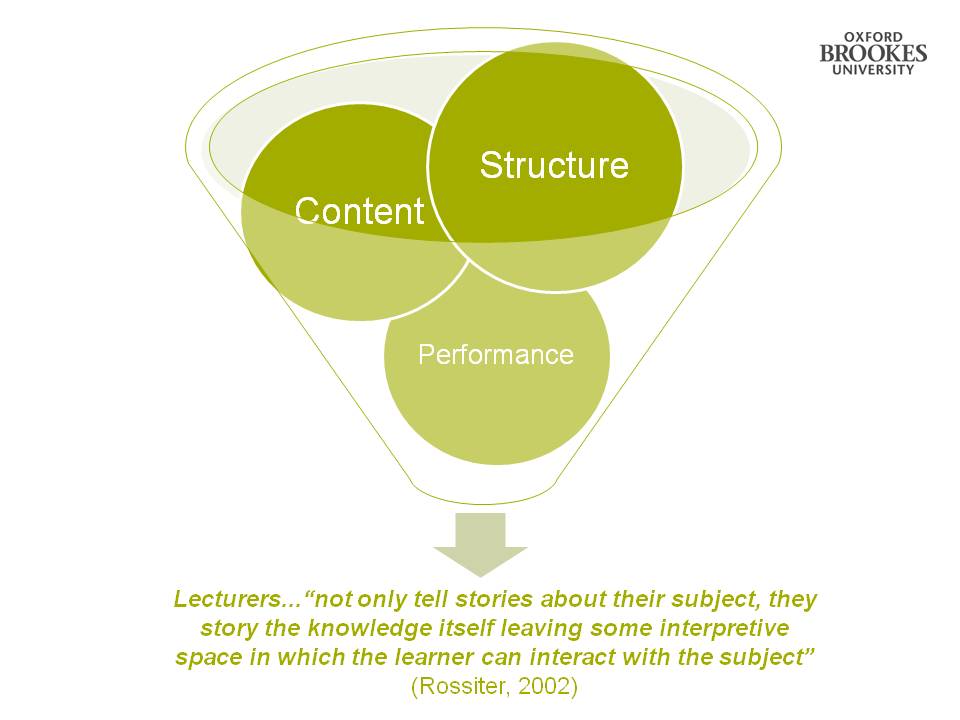
Lecturing can involve narrative in at least three interlinked ways. First, the delivery of the teaching material in a lecture can be seen as a performance by the lecturer that has to convince the student audience by invoking a response that is beyond what might be expected from a simple statement of fact or information. Simply put, the lecturer has to move the audience in order to be effective.

Secondly, pedagogical knowledge itself can be thought of as narrative as the lecturer has chosen and crafted it themselves with the student audience in mind and so the content of the lecture itself can be thought of as narrative.

Finally, the lecture can have an overall narrative structure and may also contain various narrative devices within its duration.

So why use narrative? Why not just state the facts? Rossiter’s quote hints about the engagement that narrative affords..."leaving space in which the learner can interact with the subject".


In my research I’m using a framework developed by Nancy Duarte in her book Resonate, which focuses on the importance of stories - primarily in business presentations -  as a means of persuading an audience to engage with a product, brand, mission statement, set of values etc. Duarte developed her framework by analysing famous speeches and presentations by the likes of Martin Luther King, Steve Jobs, Richard Feynmann and others. Her framework draws on literary and cinematic traditions and focuses on the importance of engaging the audience through a contrasting dramatic rhythm in presenting and a structure that makes meaning clear through impassioned contrast.

Including emotion in a lecture doesn’t mean it should be half fact and half emotion, it means introducing appeal that invokes a response in the audience. This is most easily done through the use of stories and a recognisable narrative structure.

The importance of using stories is two-fold:
  1. They contain complex information, which the audience can make meaning from and that influences and inspires them.
  2. They allow the audience to make connections, engage and empathise through emotion


Duarte’s presentational form is shown in the diagram below – it doesn’t suggest that all successful speeches or presentations should adhere to this format rigidly – it’s flexible.

Things to note:
  • There’s a clear beginning, middle and end.
  • There are two turning points in the structure to guide audience through the content and to separate the beginning from the middle and the middle from the end:
  • The first one is a call to adventure showing the gap between what is and what could be – needs to be big to jolt the audience and create imbalance that they wantto be resolved; 
  • The second is a call to action, which identifies what the audience need to do or how they need to change – this signifies that the presentation is drawing to its conclusion.
  • The back and forth structural motion pulls and pushes the audience to feels events are unfolding and so they will stay engaged as ideas and perspectives are unwrapped frequently.
    Each presentation ends with a vivid description of the new bliss that’s created when the audience adopts the new idea but note that the form does not stop here as the presentation aims to persuade the audience to complete a subsequent action afterwards – crossing the threshold.


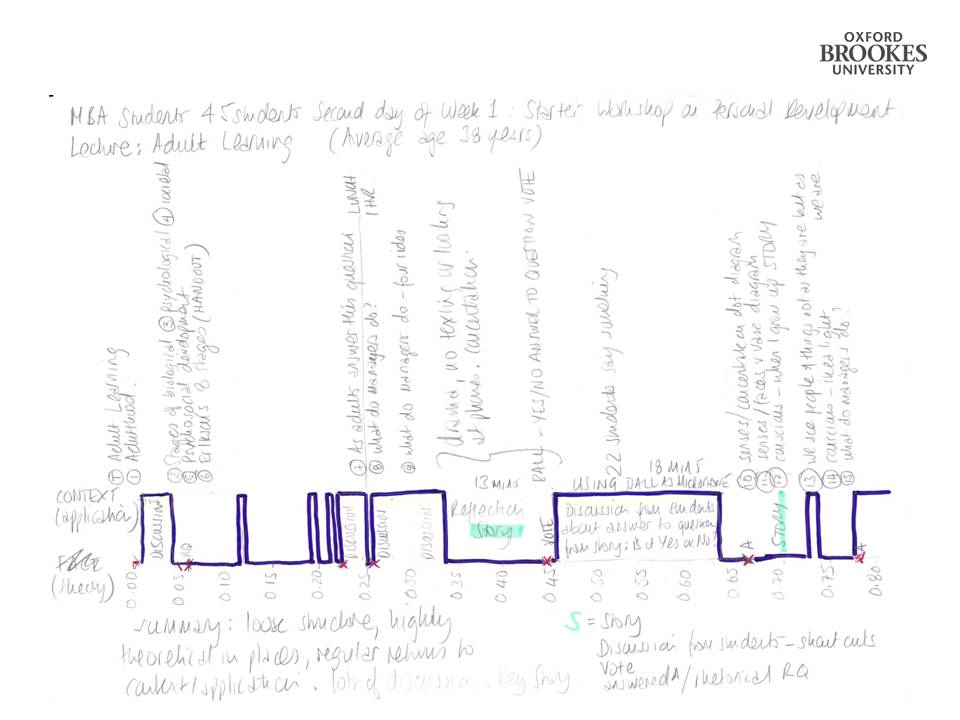
Below is a field note from one of the lectures that I have observed as part of my pilot work for my doctorate. It displays the contrasting rhythm described by Duarte but also has a planned story half-way through, which is the catalyst for a vigorous discussion amongst the class. The story is designed to create this response, rather than being a device for supporting theory or other teaching points made. I have called this type of story, Trojan Horse.


One of the clear points I noticed in observing all these lectures was the different ways that narrative was used by lecturers within their lecture. Some were designed and planned, some were spontaneous reactions, unconscious to the lecturer as stories and some had very deliberate intentions other than the story itself. So here is my typology of narrative within lectures so far.


References:

Duarte, N. (2010) Resonate – Present Visual Stories that transform Audiences. New Jersey: John Wiley& Sons
Rossiter, M. (2002) Narrative and Stories in Adult Teaching and Learning. ERIC Digest No. 241. [Online] Accessed at http://calpro-online.org/eric/docs/dig241.pdf


Tuesday, March 26, 2013

Is the Lecture Really Dead?

It all started with a Facebook page called The Lecture is Dead. About a year ago I 'liked' it but now I'm not so sure. The page states 'In schools and universities the non-interactive lecture is an outdated method of teaching. Engaging pedagogy produces better academic outcomes and a richer, more pleasant learning environment'. What's not to agree with there? However, I've come full circle on lectures and no longer think the lecture is dying or even all that ill. Part of the reason why is that whenever I read something about how poor a teaching method lectures are, there's often something contradicting this within the article itself. Here are two examples of what I mean:


(Reproduced from http://www.facebook.com/pages/The-Lecture-is-Dead/271794668781)

Enough with the Lecture Bashing

As a teaching method the lecture has long, long been criticised (for example see Bane, 1925; Bligh, 1972; Gibbs, 1981). The criticism probably goes back further than this and most of it centres around the lecture being a passive teaching method and its lack of effectiveness compared with more active learning modes. Academics such as Eric Mazur have promoted a more interactive style of lecturing, involving students discussing points and feeding answers back to the class. More recently, the concept of 'flipping' has become popular, whereby students cover lecture material away from class and the teaching time is then given over to more interactive modes of teaching.


Recently, I read this interesting blog post by journalist Anne Murphy Paul which mentions some amazing research by MIT Professor Rosalind Picard and others where students were fitted with wristbands that measured skin conductance as an index of the “arousal associated with emotion, cognition and attention.” The sensors in the wristbands recorded regular, strong spikes during periods of study, laboratory work and homework, but the readout flatlined during two activities: attending lectures and watching TV. The graph (below) of the students response is very telling with noticeable flatlining during the lectures but not, interestingly, always during sleeping.

Poh N-Z, Swenson, NC and Picard, RW (2010)*


However, whiles the research findings are clear, what I found really significant were the comments to Murphy's blog about this research, which seem to show that lack of arousal in lectures may not be an indication of lack of learning and contradict the flatlining in the graph above. Here are some of the comments:
Very interesting, though from my own experience I feel that I learned very well from lectures (and I also remember the content of books and TV programmes well too)… I agree that they are essentially passive but it is possible to be mentally engaged nevertheless. I genuinely can’t remember a single thing that I learned during homework activities. Perhaps the effectiveness of these forms of learning depends a lot on the individual. Jonathan Firth
...While I don’t think that lecture should be the only teaching strategy incorporated, I do believe that there is a place for lectures within educational institutions, especially at the collegiate level. I agree with John. Being auditory, I love a good lecture and often find myself listening to lectures on iTunes U to expand my depth of knowledge. I think what the professor does with the lecture is essential, as well as what the learner views as the purpose of the lecture is. Lectures don’t have to be passive... Stephanie Franks
Maybe they need to assess their lecturing technique at MIT. I studied psychology at NUIG Galway, Ireland, and found most if not all the lectures very engaging and worthwhile. Kevin Doyle

The authors of the comments above recall their own experiences of learning in lectures almost fondly. In a previous blog, 'What's Still Good about Lectures?' I wrote about similar positive comments in an online discussion by academics about lectures and lecturers. The idea that passive learning works well concurs with Murphy Paul's earlier article called 'Couch Potatoes, Rejoice! Learning can be passive' which espouses the effectiveness of passive learning through observation, especially if students are likely to practice or repeat what they are observing and/or have prior experience of what's being observed.

Another, very different, example of contradiction in lecture bashing is within a Guardian Education article by Anna Fazackerley which details Dale Stephens Uncollege initiative and his ethos behind it, described in his book 'Hacking Your education: Ditch the Lectures, Save Tens of Thousands, and Learn More Than Your Peers Ever Will'. Whilst I don't have any issues with Stephens basic idea of debunking the belief that going to university is the only route to success, he contradicts his own book title by suggesting that non-students should try and "attend lectures" (without enrolling) because "the academics were more than willing to host someone who genuinely wanted to share their knowledge and learn". He seems to be suggesting here that, if you don't ditch the lectures, you might learn something.

So, perhaps the case against the lecture is not so open and shut. The lecture may not be popular but I'm off the bashing bandwagon for now.


*A Wearable Sensor for Unobtrusive, Long-Term Assessment of Electrodermal Activity
Ming-Zher Poh, Nicholas C. Swenson and Rosalind W. Picard. IEEE TRANSACTIONS ON BIOMEDICAL ENGINEERING, VOL. 57, NO. 5, MAY 2010 1243


Monday, March 4, 2013

Narrative, Story and Plot and Why We tell Stories

Trying to describes what narrative is and what it isn't is complex. It's Oxford dictionary definition is 'an account that presents connected events'. This implies a linear timeline of a series of happenings and that those occurrences are connected to each other. Author Jake Arnott believes narrative is a powerful force. In BBC Radio 4's 'Something Understood' (broadcast on 5 August 2012) he suggests that the instinct to create stories is innate within people and that it is essential to our understanding of both the world and our own life. Narrative enables a person to join everything together and make sense of the series of perhaps random and unconnected events that make up the life experience.

EM Forster furthers this in Aspects of the Novel and explains the distinction between story and plot. “We have defined a story as a narrative of events arranged in their time-sequence. A plot is also a narrative of events, the emphasis falling on causality. The point about causality is key here.

“The king died, and then the queen died” is a story. 

“The king died, and then the queen died of grief” is a plot. The time sequence is preserved, but the sense of causality overshadows it. 

Or again: “The queen died, no one knew why, until it was discovered that it was through grief at the death of the king.” This is a plot with a mystery in it, a form capable of high development. It suspends the time sequence, it moves as far away from the story as its limitations will allow. 

However, Arnott takes issue with the notion of causality and argues that Forster's insistence that story, or more accurately plot, is 'mere' causality is wrong. He believes that story occurs without anything having had to happen and that it's not just an order of events. He cites Beckett's 'Waiting for Godot' as a play in which nothing much happens, and yet it resonates with a powerful sense of story.

Arnott proposes something that I haven't come across before - this idea that story or narrative can be independent of a series of events. In the programme he describes how a piece of music or works of art can have a narrative and that narrative may just be hinted at rather than formed.

I like this idea of narrative that isn't obvious and it's interesting to think about how narrative can exist without anything having happened.

Related to this, on a vicarious internet search, I found this lovely YouTube video of poet Phil Kaye. In it he talks about the first type of stories that he loved - doing impressions. He calls them 'immediate stories' that happen through changing the tone, pitch and timbre of your voice to give an entire context of belief or feeling. It occurred to me that this is not dissimilar to Arnott's idea of independent narrative.


Kaye goes on to explain his thoughts on the important question of why we tell stories. He describes the often simple intentions behind telling stories - to entertain or make some laugh, to warn, to scare or explain. This last one, to explain, is quite close to what I am researching which is the the telling of stories  in teaching.
 
Kaye suggests that we tell stories to feel alive and we do this because we like to believe our lives are a linear and predicatable set of events, which they can appear to be if looked at retrospectively. However, surrounding the narrative of events are a whole series of what-might-have-beens if, at any point, a different decision had been taken. People like to reasure themselves that they can plot out their lives and perhaps that they can control that causality mentioned earlier but there is whole area of chance surrounding the events that happen to us that makes us feel vulnerable. It is this vulnerability that is the impetus for storytelling, so we can connect with others and feel alive by marking an event.
 
So Kaye concludes that we tell stories to feel alive by making context of our past (events) whilst recognising the vulnerability that exists surrounding the narrative.


Wednesday, October 17, 2012

Stories are what make us human. We need to create new containers to tell the stories...


"Stories are what make us human. We need to create new containers to tell the stories." This was said by Dr Ramesh Raskar, a researcher at MIT's Center for Future Story Telling to Stephen Fry in Fry's Planet Word, broadcast in the UK exactly one year ago today as I type this. Dr Raskar was working on a sensory suit that would allow someone to experience the electronically captured movement of another person. Wearing the suit someone would be able to 'relive' the saved experiences of a long-gone grandparent for example - perhaps a relative you never actually knew. So the suit was the new container able to tell someones story to the wearer.

The quote about new containers to tell stories struck me a year ago when I watched the programme and I  have been periodically mulling it over since then. If a sensory suit is a new container, then what forms do the old containers take. Are they redundant and is that why we 'need' new ones?

I suppose that containers could be the oral storytelling tradition around the fire or the written word that replaced it, except that it didn't really replace it. The oral tradition is alive and well. My own city of Oxford is home to the developing Story Museum which focuses on performances, exhibitions and activities to support children's learning through stories. What is teh phenonmenal TED if not stories performed?

Likewise stories in the container of the printed word or books are still being published and sold. My husband alone keeps several bookstores in business.


Husband's book buying habits are out of control

Secondhand sellers now have access to international customers thanks to the Internet. New containers for books could be e-readers, like Kindle, but again they haven't replaced books or magazines yet.

I keep reading on social media that digital storytelling is replacing linear narrative. I'm reading Frank Rose's excellent book The Art of Immersion - how the digital generation is remaking Hollywood, Madison Avenue, and the way we tell stories. The term immersion describes the way that audiences can become individually and collectively participatory in a narrative using different media, and able to shape and transform the story in a manner that is uniquely afforded by the Internet. For me,  the books sort of builds on Janet Murray's Hamlet on the Holodeck - the Future of Narrative in Cyberspace, which amazingly was published way back in 1997. Are these (ironically) books both describing new containers for stories - ones that are digital?

I also really like Frank Rose's blog Deep Media - on narrative in the digital age. Deep media is opposite of mass media. Rose has just written his account of a recent New York conference Future of Storytelling - reinventing the way stories are told (clip about FOST below).


In his review of the conference Rose describes an  initiative where data dumps, such as real estate or sports statistics, are automatically transformed into stories by software apps (or bots). The stories render the data much more understandable to readers trying to comprehend performance and trends. So maybe our stories are destined to come from bots and not brains via books in the near future. Strange to think that the quote at the beginning 'stories are what makes us human' can lead to a scenario where ro(bots) are creating the stories.

Finally, I am looking forward to reading Jonathan Gottschall's book - The Storytelling Animal - How Stories Make Us Human which seeks to explain how stories change our behaviour.


Tuesday, August 7, 2012

PowerPoint used to tell a story

There's been so much PowerPoint bashing over the years (see my earlier post on this), with Edward Tufte and many others criticising the use of the software in business and education. PowerPoint is often accused of creating a focus on format rather than content, encouraging 'lazy' presentations and even being so boring as to cause death (by PowerPoint)!

However, I have just finished a novel in which one chapter is written using only PP slides. The idea of using PP software in storytelling almost seems to contradict the arguments levelled at its use in business and education.

Having an interest in the role of narrative in the lecture, I was really looking forward to reading Jennifer Egan's A Visit from the Goon Squad, and seeing how she used PP in fictional literature.

Jennifer Egan's A Visit from the Goon Squad

I read the paperback version of the book but apparently in the Kindle version the PP actually launches and you read the chapter as an actual presentation of the slides rather than a series of pages, as you do in the book version (see photo below). The chapter is written from the perspective of Alison Blake, a young American pre-teen, who expresses herself in the graphs and SmartArt of PP rather than traditional prose. Part of the narrative involves Alison's take on her brother Lincoln's actions and communication with other members of the family.


A page from the PowerPoint chapter

I really enjoyed the book, which has been a tremendous success for Egan, winning the Pulitzer Prize for fiction. It employs quite a loose narrative structure where a series of short stories are linked through a shared character in each sucessive story, with an arc that comes back to first story.

The use of PP works very well for a single chapter but I'm not sure it could have been sustained for the whole, or the majority, of the book. It works so well because PP forces a different pace of narrative compared with the other chapters. It manages this by focusing on a set of significant moments, rather than the links between events. Egan, herself has said that she found PP very good for inserting visual pauses into the story, which is not something that can be done in traditional prose.

Anyway, Egan is a PP novelist having created PP fiction and has written a blog giving advice on how to tell stories using PP.


Monday, April 2, 2012

The Traditional Lecture and Fumbling with PowerPoint

In his recent article for The Guardian Higher Education Network on the early adopter universities that are leading the way with educational technology, Steven Schwartz describes how, in the near future, technology will be tailored to students' needs and that online offerings will not be "merely... images from a camera plonked in front of a traditional class with a traditional lecturer fumbling with a traditional PowerPoint presentation".

This got me thinking as to how ubiquitous PowerPoint (PP) has become in the standard university lecture. What percentage of lectures are delivered through the medium of PowerPoint, Keynote or other presentational technology? Of course it may depend on the discipline but, from my own experience, I would hazard a guess that well over 50 per cent of all lectures are being communicated using PP. This means, as Schwarz states, that 'fumbling' with PP for a lecture is now tradition, it's now the norm.

The research on the use of PP for lectures is polarising. There's research on how students much prefer lectures with PP and the notes that can be generated to accompany the lecture (for example see Nicholson, 2002; and Amare 2006) and yet there is also evidence on how much students dislike PP. This heartfelt quote is from a series of comments on a blog giving tips for lecturing medical students;

"I could simplify all the advice to lecturers by saying only: Don't use PowerPoint! Anything else you do will be brilliant compared to even the best PP lecture. I promise".

The issue I want to raise here is that the advent of presentational technology in the lecture hall may well be an example of technology making things worse rather than better. Most disruptive technological innovations result in changing the market by replacing one technology with a newer one that creates a value network. Before presentational technologies, lecturers used acetate overheads, a carousel of photographed slides, photocopied handouts, whiteboards or blackboards. The growth of the use of PP for lecture presentations has been immense and yet it's not at all clear that this technological disruption has added any value. In fact, there are some clear arguments that it has had adverse effects on teaching and learning.

Most notable of these is Tufte (2003), who derided PP's “preoccupation with format not content”. Lowenthal (2009) suggests that presentational software encourages a lecturer-centred, screen-centred and technology-centred lecture. James et al. (2006) gives an account of the research into the impact of PP based lectures on cognitive recall. Overall here and elsewhere, the results seemed mixed as to whether recall is helped or hindered.

Rather than rehashing whether PP is good or 'evil' (Tufte again), there are several other points I want to make specifically about the use of it for delivering lectures.
 
First, irrespective of whether individual lectures using PP are any good or not, there has been little thought given to the students' experience over several of these lectures during a busily timetabled day. Contrast this with the 'Death by PowerPoint' feeling that any lecturer at conference knows only too well.  Do we ever think about our students' experience across a set of PP lectures? Do we ever ask about this in evaluations?

Second, in most of the formats that PP has largely replaced, there is an ability to annotate or adapt content in real time that is almost completely missing from PP.  Instead PP lectures are presented as complete and fixed, which means that opportunities for digression are difficult because there will be no slides to support those asides and, indeed no accompanying notes. This may mean that students regard any departures 'off script' as less important, when in fact they may be the exact opposite. In addition, the complete linear format of PP lectures mean that a lecturer must make it through all of their slides within the alloted time or else leave the students hanging in some kind of unsatisfactory PP interruptus, robbed of the full experience. All in all it's difficult to see how this lack of flexibility can be a step forward.

Finally and related to the previous point, earlier methods afforded the student audience the opportunity to see the 'crafting' of lecture as the lecturer built up the points through scribbling on an overhead projector with different coloured pens or executed teasingly slow reveals of covered up points on acetates. There was also the performance art that was, first the erasing of a previous lecturer's work from the black/white board and then the filling up of every centimetre of space with an equally transient set of points, to stand somewhat exhausted in front of their finished artefact at the end of an hour. This evidence of effort and of the enthusiasm of the lecturer is crucial, according to Aarabi (2007) who explains how this performance element demonstrates to students the effort that has gone into the lecture. It creates both an authenticity for the students and also an appreciation because the lecture has been bespoke for them. This contrasts strongly with the PP lecture, where this effort is hidden from the student and the ease with which the lecturer moves from one slide to another belies the work that has gone into its construction beforehand.

Of course there are brilliant PP lectures with content, images and video that far surpasses anything that earlier technologies could achieve, but I think these are rare amongst the bread and butter PP university lectures. Perhaps PP has contrained rather than enabled the lecture


Sunday, March 11, 2012

What's the Use of Lectures?

After a lot of thinking, discussing and soul searching I decided last year that there was a topic I was so interested in that I wanted to spend a goodly amount of time researching it seriously. Fast forward six months and I have submitted a doctorate application to a university and am awaiting a decision. I am pleased and excited for several reasons. First, because I actually managed to find the head space and time to do some reading and thinking about my topic. Second, because I went beyond my usual procrastinating to actually writing down my thoughts and creating what I think is a reasonable proposal. Third, because I was organised enough to marshall my qualification transcripts, examples of other written work, references and my CV for uploading into my online application before the deadline. In fact, I think I should get a qualification just for getting the application in. Most of all I am excited because in doing all of the above I realised how much I want to do this research. For the first time in a long time I am  interested in something for its own sake and it feels great.

My research topic is the result of being influenced by two books - yes real books! The first one is a classic research text, first published in 1972. It's by Donald Bligh and is called 'What's the Use of Lectures?'. The second book was published much later in 2010, it's by Nancy Duarte and is called 'Resonate - present visual stories that transform audiences'. These two books are the ingredients behind what I want to look at which is whether the university lecture has a narrative or story structure.


Two books that have influenced me

Bligh's book, which has been republished many times in the forty years since 1972, details the plethora of research that has been carried over many years to show that (in a nutshell) the lecture as a teaching method is only effective at the transmission of factual information, and even at this it is no better than other teaching methods. In essence, this book and many other sources describe how unfit for educational purpose the standard university lecture is.

My starting point in thinking about the lecture was a growing dismay at the poor use of presentational technologies, such as PowerPoint, by lecturers during their teaching sessions. I include my own lectures in this.  Imagine the experience of the average fresher sitting in the darkened lecture theatre on week one of their degree waiting expectantly for their lecturer to deliver the very first lecture. The average student will experience between 250-300 lectures, probably most using PowerPoint, before they emerge after three years with their qualification.

When Bligh wrote his book, PowerPoint and Keynote were a long way off. So imagine that not only are lectures not an effective method of teaching, they may have actually been made worse by the use of new technology. That's not progress.

Stories, storytelling and narrative have long had a role in education, including higher education. Stories and narrative help with meaning making of experiences. Duarte's book describes how story structures are found in many great speeches, presentations and artistic performances and how they are fundamental to communication. So if a company wants to inspire change in its employees or if a politician wants to elicit loyalty in their followers, they use narrative to connect with their audiences, create support for their vision and effect change in people.

Here she is talking about her 'Resonate' approach.


My starting point on this was wondering if Duarte's ideas could be applied in a higher educational context to the humble lecture? Surely the goal of education is to inspire, move and change people. Perhaps narrative and stories offers a way forward for the much maligned (probably PowerPoint-based) lecture.

I hope we shall see.